AC Not Cooling? Here's Why — And How to Fix It Fast
Your air conditioner is running, but the house is not getting any cooler. Before you panic and call for emergency service, walk through these nine checks that solve most cooling problems — some you can fix yourself in under five minutes.
It is 95 degrees outside, you have been out on Grand Lake all day, and you walk into a house that feels like it is barely cooler than outside. The AC is running — you can hear it — but the air coming out of the registers is warm or barely cool. Do not call for repair yet. About 40 percent of "AC not cooling" calls we respond to in the Grand Lake area are caused by things the homeowner can fix in minutes.
⚡ The most common reasons your AC is not cooling:
- 1. Dirty or clogged air filter
- 2. Thermostat set incorrectly
- 3. Blocked or dirty outdoor condenser unit
- 4. Tripped circuit breaker
- 5. Frozen evaporator coils
- 6. Refrigerant leak or low refrigerant
- 7. Blocked vents or registers
- 8. Dirty evaporator coils
- 9. Unrealistic temperature expectations on extreme heat days
Steps 1–5 are DIY fixes. Steps 6 and 8 require a licensed HVAC technician.
Check Your Air Filter
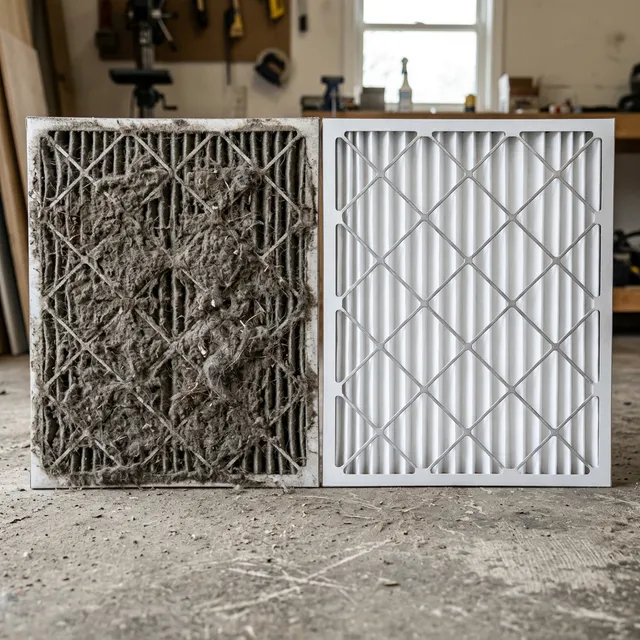
This is the number one cause of poor cooling. A clogged filter restricts airflow, which causes the evaporator coil to freeze, which means your AC literally blows warm air. In the Grand Lake area — with dusty gravel roads, pollen from surrounding forests, and lake humidity — filters clog faster than in most places. Check it monthly and replace every 30–90 days.
DIY fix: Pull out the filter (usually behind a return air grille or at the air handler). If you cannot see light through it, replace it. Standard 1-inch filters are available at Dollar General and Walmart in Grove.
Check Your Thermostat Settings
It sounds obvious, but we see this constantly: the thermostat is set to HEAT instead of COOL, or the fan is set to ON instead of AUTO. When the fan runs continuously (ON mode), it blows air even when the compressor is not running — which means you feel warm air from the registers between cooling cycles.
DIY fix: Set the system to COOL and the fan to AUTO. If your thermostat screen is blank, replace the batteries (usually 2 AAs behind the faceplate).
Look at Your Outdoor Unit
Go outside and look at the condenser unit. Is the fan spinning? If it is not spinning but you can hear a humming, the fan motor or capacitor may have failed — this is a common issue in Oklahoma summers when outdoor temperatures exceed 100°F and the capacitor overheats.
Also check for debris. Cottonwood fluff (extremely common around Grand Lake in June), leaves, and tall grass can block the condenser fins and drastically reduce cooling efficiency. You need at least 2 feet of clearance on all sides.
DIY fix: Gently hose down the condenser fins (not a pressure washer). Clear any vegetation. If the fan is not spinning, turn off the system and call us — a locked-up fan motor can burn out the compressor.
Check Your Circuit Breaker
Your AC has two breakers — one for the indoor air handler and one for the outdoor condenser. If only one trips, the fan may run (you hear the system) but the compressor does not (no cooling). Thunderstorms near Grand Lake frequently cause power surges that trip breakers.
DIY fix: Check your electrical panel. If a breaker is tripped, flip it fully OFF then back ON. If it trips again immediately, do not reset it again — there is an electrical problem that needs professional diagnosis.
Frozen Evaporator Coils
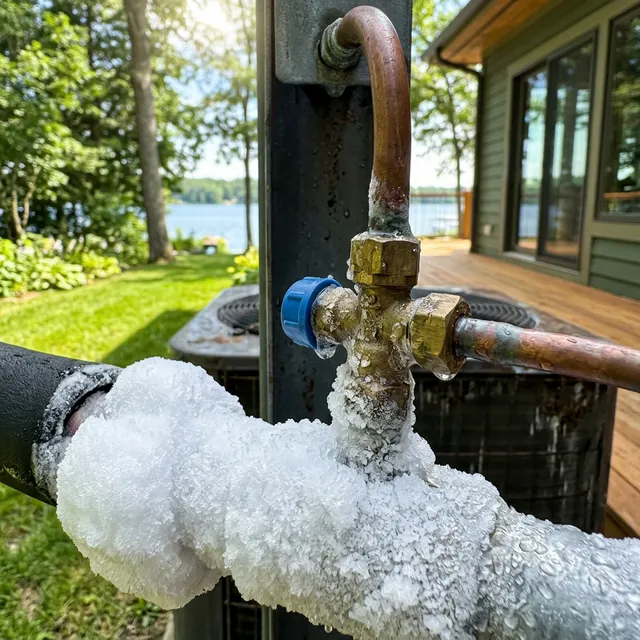
Look at the copper refrigerant lines running between your indoor and outdoor units. If there is frost or ice on them, your evaporator coil is frozen. Frozen coils can't absorb heat, so your AC blows warm air even though it is running. This is usually caused by a dirty filter (step 1), low refrigerant, or a blower motor problem.
What to do: Turn off the AC but leave the fan set to ON. This blows warm air over the frozen coil to melt the ice. Wait 2–4 hours, then try running the AC again with a clean filter. If it freezes again, you likely have a refrigerant leak — call Cozy Llama.
Refrigerant Leak or Low Refrigerant
Refrigerant is what actually removes heat from your home's air. If your system is low on refrigerant due to a leak, it simply cannot cool — no matter how long it runs. In Oklahoma's brutal summers, this is one of the most common reasons for a sudden loss of cooling in an older system.
Signs of a refrigerant leak: warm air from registers, ice forming on the refrigerant lines, hissing or bubbling sounds near the indoor unit, and higher-than-normal electricity bills. Unlike a car, your AC does not "use up" refrigerant — if it is low, there is a leak that needs to be found and repaired.
⚠️ This is not a DIY fix. Only a licensed HVAC technician can legally handle refrigerant. Simply topping it off without fixing the leak is a waste of money — it will be low again within weeks. Call Cozy Llama to locate and seal the leak properly.
Check Your Vents and Registers
Walk through every room and make sure all supply registers are open and unblocked. Furniture placed against registers, closed registers in unused rooms, or a rug draped over a floor vent can restrict airflow enough to starve the system. Your AC needs to push a certain volume of air to operate correctly.
Dirty Evaporator Coils
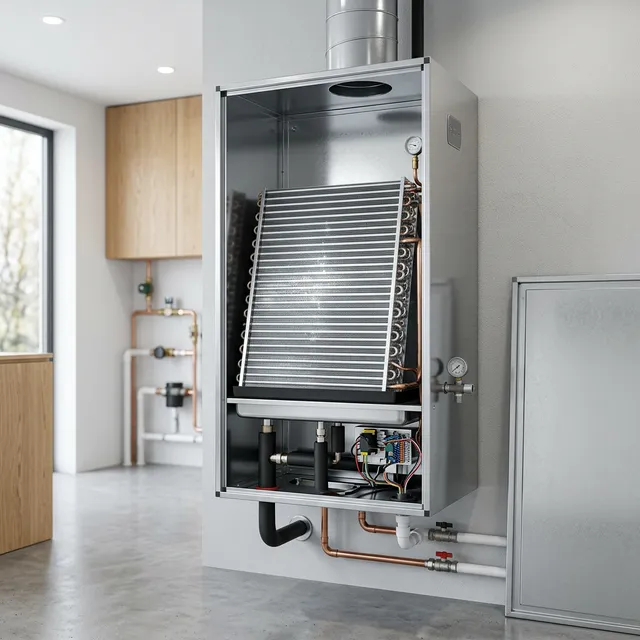
Even if your filter is clean, the evaporator coils inside your air handler can accumulate a layer of dust, mold, or debris over time. Dirty coils can't absorb heat efficiently — the result is an AC that runs constantly but barely cools the house.
This is less of an emergency fix and more of a maintenance issue. If you have not had your system serviced in over a year and cooling has gradually gotten worse, dirty evaporator coils are a likely culprit. Because this coil sits inside the air handler, buildup comes from airborne dust, pet dander, and mold spores that pass through the filter over time — not outdoor debris like cottonwood.
Fix: Evaporator coil cleaning is best done by a professional with the right tools and coil cleaner. Schedule a tune-up and we will clean the coils, check refrigerant levels, and make sure your system is ready for summer.
Set Realistic Expectations
Here is something most HVAC companies will not tell you: your AC is designed to maintain about a 20-degree temperature difference from the outside. On a 105°F Oklahoma July day, your system can realistically keep the house around 80–85°F, not 68°F. If the temperature outside is extreme and your house is cooling but slowly, your system may actually be working correctly.
However, if the house is not cooling AT ALL — or the temperature is rising while the AC runs — that is a real problem and it is time to call for repair.
When to Call Cozy Llama
If you have worked through all nine steps above and your AC still is not cooling, it is time for professional help. Common issues that require a technician include:
- •Low refrigerant — indicates a leak that needs to be found and sealed
- •Failed capacitor — the most common part failure in Oklahoma summers
- •Bad contactor — the relay that turns the compressor on and off
- •Compressor failure — the most expensive repair, may warrant replacement
- •Ductwork leaks — conditioned air escaping into your attic or crawlspace
Cozy Llama Heating & Cooling offers flat-rate diagnostics with upfront pricing — no hidden fees, no surprises. We are based in Eucha and serve all Grand Lake communities including Grove, Jay, Monkey Island, Vinita, and Pryor.