Home / Heating / Heat Pumps

Year-Round Comfort · Grand Lake OK & NE Oklahoma

Heat Pump Repair & Installation in Grand Lake & NE Oklahoma

One system. All seasons. Efficient heating and cooling from a single unit — and we specialize in weird heat pump noises and defrost issues.

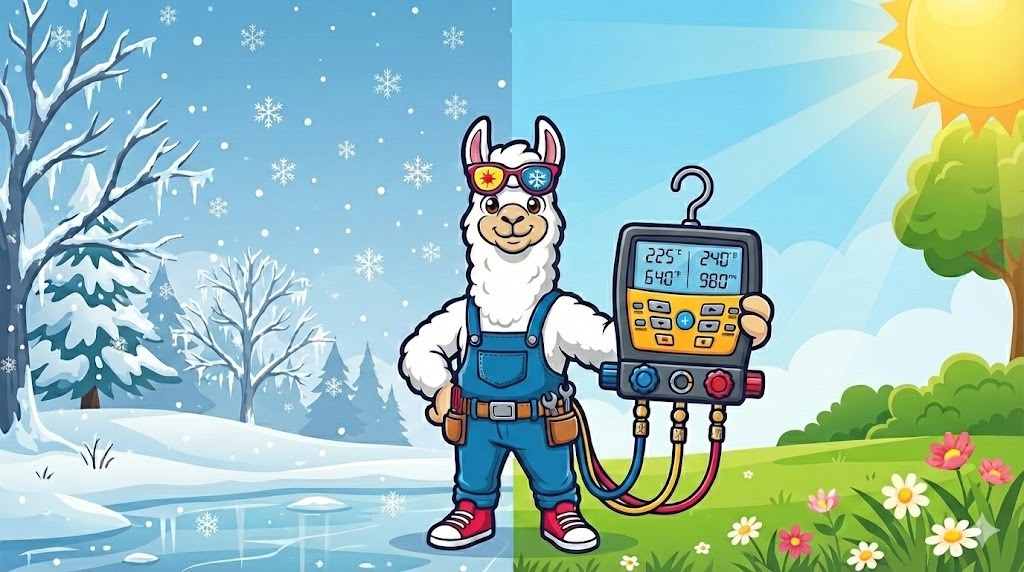
Cozy Llama mascot holding digital refrigerant gauges, standing between a snowy winter scene and a sunny summer scene

A heat pump is one system that heats and cools — it moves heat instead of burning fuel, which is why it fits Northeast Oklahoma's mild winters so well. Cozy Llama installs, repairs, and tunes air-source, ductless, and dual-fuel heat pumps across Grand Lake and NE Oklahoma, with an upfront price before we start. Ice on the unit, AUX heat stuck on, or lukewarm air? Start with the Defrost Decoder below, then call (918) 789-0427.

Interactive symptom checker

The Defrost Decoder

Heat pumps act differently than furnaces. What's "Drama" and what's normal?

See it work · interactive 3D

Same machine, both seasons.

A heat pump moves existing heat from outside air into your home — it does not create heat, it transfers it. In summer it runs the same trick in reverse. Here's the same system in summer, in winter, and in the middle of a defrost cycle.

01 · Summer (cooling)

Summer: heat goes out.

The indoor coil soaks up heat from your air. The big insulated copper line carries it outside, and the outdoor fan throws it out the top — that's the warm air you feel next to the unit.

The trick that makes it a heat pump is the reversing valve inside the outdoor unit. In winter, it flips.

The Armstrong Air A7CP21V in this demo, as rated by Armstrong Air:

SEER2 up to 21, HSPF2 up to 10ENERGY STAR® Cold Climatesound as low as 62 dBA

02 · Winter (heating)

Winter: the loop runs backward.

  1. First cold morning: you switch it to Heat
  2. Reversing valve shifts to heating (whoosh!)
  3. Flow reverses: hot gas heads inside
  4. Outdoor coil runs cold, soaks up heat
  5. Indoor coil warms the air to your vents

After that it stays in heating all winter. The whoosh you hear on cold days is defrost.

Unlike a gas furnace that blows 120°F air, heat pumps produce a 'gentle' heat (around 90-100°F).

Armstrong Air rates the A7CP21V for

operates from –22 °F to 115 °F

03 · Defrost mode

“There is ICE on my unit!”

In winter, it's normal for a heat pump to develop a light frost. The unit will automatically enter 'Defrost Mode' to melt it.

  1. Frosted coil after 30-90 min of heating: the control starts a defrost
  2. The valve shifts to cooling; the outdoor fan stops
  3. Frost turns to slush; meltwater drains
  4. Backup heat keeps your air from going cold
  5. Coil hits about 65°F: the valve shifts back
  6. Fan restarts: steam rises. Not smoke!
  7. Back to normal heating

Typical timing. Armstrong Air says a defrost cycle lasts 5 to 15 minutes; every brand's control differs a little. With a dual-fuel system, your gas furnace is the backup heat instead of electric strips.

04 · When to call us

Frost is normal. These aren't.

  • A solid block of ice. If the ice is a thick block that won't melt after 30-60 minutes, or spans the entire unit, it's not defrosting correctly.
  • AUX heat that won't quit. If it stays on all day even when it's 40°F+, your heat pump might need a tune-up to regain its efficiency.
  • Lukewarm air, cold house. If the house isn't reaching your set temperature, we should check your refrigerant levels.

Illustration · Armstrong Air A7CP21V Pro Series heat pump + 7AH2AV air handler

The parts, in plain English

  • Reversing valveThe part that flips summer to winter. It decides which way the heat travels.
  • Vapor line (the big one)Insulated copper. Cool refrigerant heads outside in summer; hot refrigerant heads into the house in winter.
  • Outdoor coilThrows heat off in summer. In winter it runs colder than the outside air to soak up heat — which is why it can frost over.
  • Indoor coilCold in summer, warm in winter. Your air passes through it on the way to the vents.
  • Outdoor fanPulls air across the coil and out the top. It stops during defrost so the coil can warm up.
  • Backup heat stripsElectric heat — the “AUX heat” on your thermostat. It helps on the coldest nights and during defrost.
  • Communicating controlThe outdoor unit's brain. Among other jobs, it decides when to defrost.
  • ThermostatHeat, cool or AUX — it tells the whole system what the house needs.

How we work

The "No Drama" Process

🚨

Rapid Dispatch

We don't leave you in the cold. We head over ASAP to get the heat back on.

🛡️

Upfront Pricing

You get a firm quote before we touch a tool. No surprise bills.

🤝

Honest Solutions

We'll never sell you a repair you don't need. If it's not worth fixing, we'll tell you the truth.

Financing Available

Finance Your Comfort

We've partnered with Wisetack to offer flexible options. Finance projects up to $25,000 with terms from 3 to 60 months.

  • ✅ Approved for up to $25,000
  • ✅ Fast & easy application
  • ✅ No hidden fees
Check Your Options

Prequalify in 60s

Does not affect credit score

Join the Club!

Llama Loyalty Members get priority "Front of the Line" service during winter storms.

VIEW PLANS
🦙 Llama Local Tip

Dual-Fuel is the Grand Lake Sweet Spot: NE Oklahoma gets maybe 10-15 days per winter below 25°F — the point where heat pumps lose efficiency. A dual-fuel system automatically switches to gas furnace backup only on those coldest days, then back to the efficient heat pump when temps rise. The heat pump carries the mild days and gas takes the coldest ones, which can lower your yearly heating costs compared to gas alone — how much depends on your gas and electric rates. We have been installing dual-fuel systems since 2022 and it is our most-recommended setup for Grand Lake homes.

Frequently Asked Questions About Heat Pump Installation & Repair

Is a heat pump a good choice for Northeast Oklahoma?
Yes, heat pumps are an excellent choice for this area. Oklahoma has relatively mild winters with average lows around 25–35°F, which is well within the efficient operating range of modern heat pumps. Many Grand Lake homeowners save 30–50 percent on heating costs compared to electric furnaces.
What is the difference between a heat pump and a furnace?
A furnace creates heat by burning gas or using electric resistance coils. A heat pump moves existing heat from outside air into your home — it does not create heat, it transfers it. This makes heat pumps 2–3 times more energy-efficient than furnaces in mild climates like Oklahoma.
How long does a heat pump last?
A well-maintained heat pump typically lasts 12–15 years. Because heat pumps run year-round (cooling in summer and heating in winter), they work harder than a furnace-only setup. Regular maintenance through our Llama Loyalty Club helps maximize lifespan.
Can a heat pump work when it is really cold outside?
Modern heat pumps work efficiently down to about 25–30°F and can still function down to 5°F or lower, though efficiency drops. For the handful of sub-zero days Oklahoma occasionally gets, a dual-fuel system pairs a heat pump with a gas furnace backup for the best of both worlds.
🌊

Serving Grand Lake: Heat Pumps Around the Lake

We install, repair, and tune heat pumps and dual-fuel systems in Grove, Jay, Langley, Ketchum, Disney, Monkey Island, Cleora, Eucha, and Bernice. Our Eucha shop is 15–35 minutes from most Grand Lake O' the Cherokees communities, so a defrost problem or an AUX-heat question is a short trip for us.

In Grove? See heat pump installation and repair in Grove, OK for which setup fits a Grove home. The Grand Lake HVAC hub covers the rest of the lake.

Where We Offer Heat Pump Installation & Repair Near Grand Lake & NE Oklahoma

Cozy Llama provides expert heat pump installation & repair service across NE Oklahoma. Click your town to learn more about HVAC services in your area.

View Full Coverage Map →

Save the drama, call the Llama.

Heat pump repair, installation & maintenance across Grand Lake and Northeast Oklahoma — air-source, ductless, and dual-fuel systems. Call for heat pump service:

📞 (918) 789-0427

or book online