Nothing wakes a household faster on a 25°F Northeast Oklahoma morning than holding your hand over a supply vent and feeling chilly room-temperature air. Before you assume the whole furnace is toast, work through these seven checks in order — four of them cost nothing to verify yourself.
If you smell rotten eggs (natural gas or propane odorant) or hear a carbon monoxide alarm, stop troubleshooting immediately. Leave the house without flipping light switches, call 911 or your gas supplier from outside, and call Cozy Llama at (918) 789-0427 once responders clear the home.
1.Thermostat Fan Switched to ON Instead of AUTO
This accounts for a surprising share of November service calls around Grand Lake. When your thermostat fan setting is on ON, the indoor blower circulates house air continuously — even during the 40 minutes each hour when the burners are resting. Moving 68°F air across your skin feels cold even when the furnace heated the room ten minutes ago.
Flip the fan setting from ON back to AUTO so the blower runs only when the heat exchanger is hot. While you are there, confirm mode is set to HEAT and install fresh alkaline batteries if the screen flickers.
2.Give It 90 Seconds (Normal Warm-Up Delay)
When a gas or propane furnace first receives a call for heat, it runs a strict safety sequence: draft inducer fan, pressure switch check, 15-second pre-purge, hot-surface igniter glow, burner ignition, and a 30-to-45-second heat-exchanger warm-up before the main blower starts. If the system just clicked on, wait two full minutes before judging vent temperature.
3.A Clogged Air Filter Tripping the High-Limit Switch
If your furnace blows warm air for three minutes, suddenly turns lukewarm or cold while the blower stays loud, and repeats that loop over and over, you are watching high-limit short cycling. Gravel-road dust, fall leaf pollen, and pet hair around Jay, Grove, and Colcord pack 1-inch filters fast. Starved of airflow, the heat exchanger overheats and trips its high-limit safety switch — cutting gas to the burners while forcing the blower to stay on to dump excess heat.
Slide out the air filter and hold it toward a lamp. If you cannot see light clearly through the pleats, put in a clean filter, make sure supply registers aren’t covered by rugs or furniture, and give the limit switch 10 minutes to cool and reset.

4.A Dirty Flame Sensor Shutting Burners Off After 4 Seconds
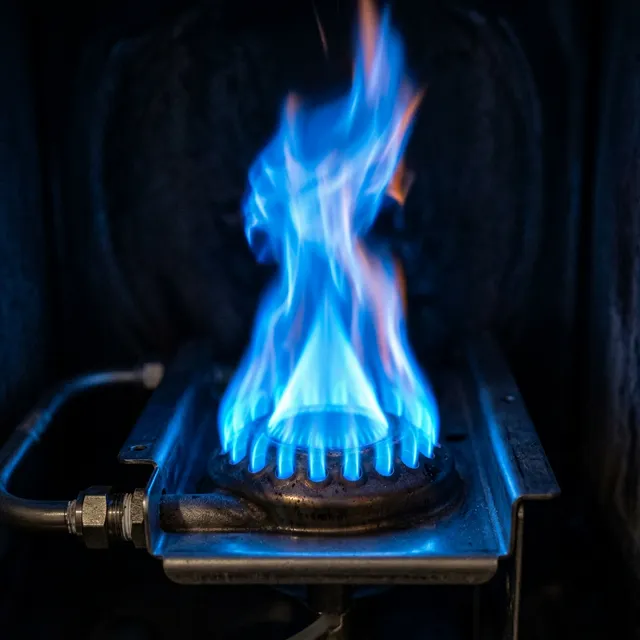
Stand by the furnace cabinet during a heat call. Do the burners whoosh to life with blue flame and then click right back off three to five seconds later? That is the textbook signature of an oxidized flame sensor — a slender stainless rod sitting in the burner path that proves fire via micro-amp current. When combustion residue coats the rod, the control board assumes unburned gas is flowing without flame and slams the gas valve shut. After three or four retries, the board enters safety lockout while the blower or inducer keeps spinning.
Pro fix: You can watch this exact failure step-by-step in our interactive 3D walkthrough on our Furnace Repair page. Our techs clean or replace the flame rod and verify micro-amp readings in minutes.
5.A Cracked Hot-Surface Igniter
Most furnaces built in the last two decades use a brittle ceramic hot-surface igniter rather than a standing pilot light. When hairline cracks develop, the draft inducer hums at the start of a cycle, the gas valve clicks briefly, and nothing ever glows orange or lights. Because silicon-nitride and silicon-carbide igniters shatter if touched with bare skin oils, leave swap-outs to a stocked service truck.
6.Empty Propane (LP) Tank or Frozen Regulator at the Lake
In rural Delaware, Mayes, and Craig counties — especially Monkey Island, Cleora, Eucha, and outer Grove lake coves — thousands of furnaces run on propane rather than city gas mains. If the tank drops below 5–10% during a cold snap, vapor pressure plummets and the furnace locks out on ignition failure. Walk outside and check the gauge under your tank dome before booking a repair call.

7.Your “Furnace” Is Actually an All-Electric Heat Pump
Around Grand Lake, plenty of homeowners call their indoor air handler a furnace when the home is actually heated by an outdoor heat pump. Two things trip people up here: first, healthy heat pump air feels gently warm (roughly 90–100°F) rather than scorching hot; second, if the outdoor coil is encased in solid ice or a reversing valve/auxiliary heat strip fails, vents truly blow cool air. Read our companion guide on what to do when a heat pump freezes up in winter.
Furnace Cold-Air FAQ
Why is my furnace running but blowing cold air?
Why does my furnace blow warm air for a few minutes and then turn cold?
Should I keep resetting my furnace breaker if it locks out?
Could my “furnace” actually be a heat pump running in defrost?
Still Blowing Cold Air?
Flat-rate diagnostics, stocked vans, and upfront pricing across Grand Lake & NE Oklahoma.