
Damp 34°F mornings off Grand Lake O’ the Cherokees are prime frost-making weather for outdoor heat pumps. Walking outside to see white frost — or a cloud of white vapor rising off your unit — can look alarming, yet half the time your heat pump is doing its job automatically. Here is how to tell healthy winter behavior apart from a freeze-up that can wreck fan blades or a compressor.
Normal Frost & “Smoke” vs. True Ice Lockup
In winter heating mode, your outdoor heat pump coil runs colder than the outdoor air so it can absorb heat energy and pump it indoors. Whenever humid lake air crosses a sub-freezing coil, moisture freezes into a light, powdery frost — just like frost inside a freezer.
- Healthy frost + defrost: A thin white rime across the fins that clears completely every 30–90 minutes. During defrost, the outdoor fan stops, a whoosh sounds from the reversing valve, and billowing white water steam rises for 5–10 minutes while indoor backup heat keeps vents warm.
- True breakdown (call for service): Thick, clear or opaque solid ice bridging across the outer louver grille, encasing copper lines, locking the top fan blades, or staying frozen longer than two hours while indoor temperature drops and
AUX HEATstays on nonstop.
Never chip, pry, or hammer ice off the outdoor coil with a screwdriver, knife, or shovel — one slip punctures a pressurized copper refrigerant tube and turns a small sensor repair into a major coil replacement. Skip boiling water too; in freezing Oklahoma wind it thermal-shocks metal joints and refreezes into a thicker slab at the base pan.
Walk to your indoor thermostat and switch mode from HEAT to EM HEAT (Emergency Heat). That immediately shuts off the iced-up outdoor unit so spinning fan blades cannot strike ice, while keeping your home warm via indoor electric heat strips or your dual-fuel gas/propane furnace until our tech arrives.
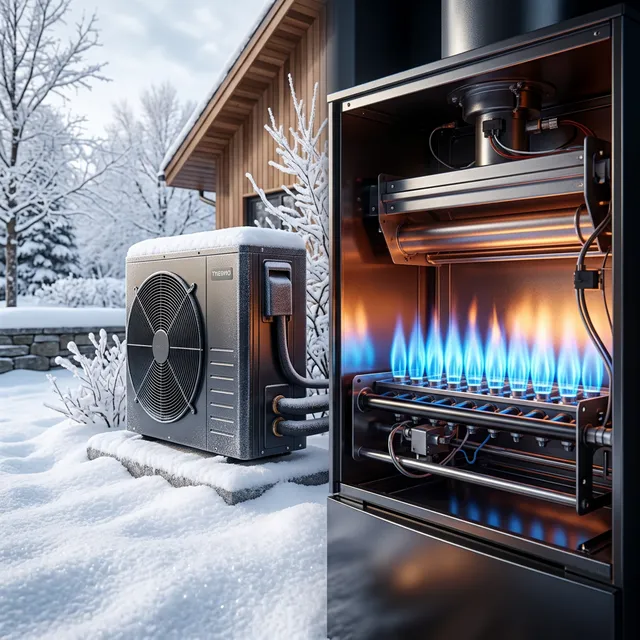
5 Reasons Grand Lake Heat Pumps Freeze Solid
- Failed defrost control board or coil sensor: If the thermistor clipped to the outdoor coil drifts out of calibration, the board never realizes ice has formed and skips defrost cycles altogether.
- Bad outdoor fan motor or run capacitor: Without the fan pulling outdoor air across the fins, coil temperature plummets and moisture turns into a solid glacier within hours.
- Low refrigerant charge from a small leak: Undercharged coils run artificially cold in winter just like they freeze indoor evaporator coils in July.
- Roof valleys or leaky gutters dripping onto the top grille: Freezing rain or snowmelt pouring straight onto the fan guard freezes faster than any defrost cycle can clear.
- Leaves or snow blocking base-pan drain holes: Melted defrost water has to drain out the bottom pan. Packed oak leaves or a sunken concrete pad trap standing water that refreezes upward into the coil.
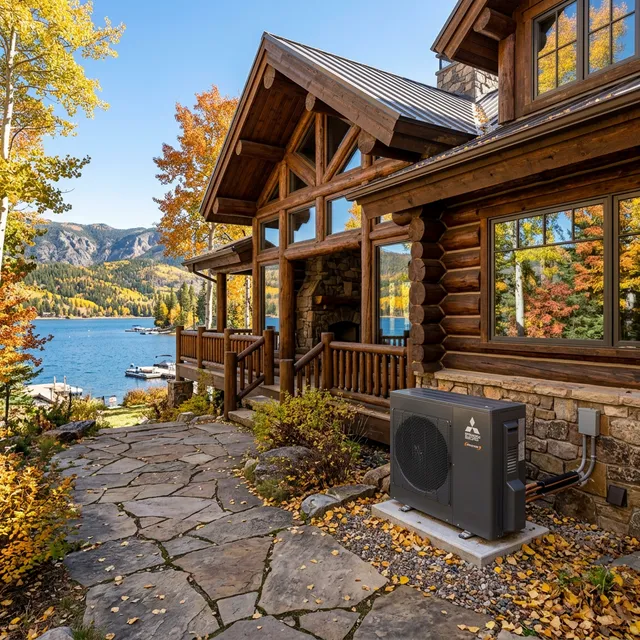
Upgrading an Older Heat Pump? Cold-Climate Tech Changed the Game
Older single-stage heat pumps struggled once Northeast Oklahoma temperatures dipped into the 20s, relying heavily on expensive electric strip heat. Today’s variable-speed inverter systems — including the Armstrong Air Pro Series cold-climate heat pumps we install in Grove, Jay, Monkey Island, and across Grand Lake — use demand-based smart defrost (defrosting only when frost actually forms rather than on a dumb timer) and are rated to extract outdoor heat all the way down to -22°F.
Frozen Heat Pump FAQ
Is frost on my outdoor heat pump normal in winter?
Why does my heat pump look like it is smoking in winter?
Should I chip ice off my heat pump coil or pour boiling water on it?
What should I set my thermostat to if my heat pump is encased in solid ice?
Heat Pump Iced Over Around Grand Lake?
Switch to EM HEAT and give us a shout — flat-rate diagnostics and upfront pricing.